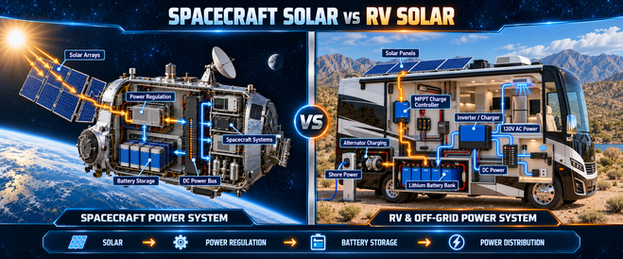
Why RV Solar?
Freedom, Quiet Power & Off-Grid Independence
RV solar is about more than placing panels on the roof. A properly designed RV power system combines solar charging, lithium battery storage, an inverter/charger, alternator charging, shore power and intelligent monitoring so your vehicle can supply dependable power wherever you travel.
Whether you want a quiet weekend away from crowded campgrounds, reliable power for work and communication, or a complete off-grid system capable of supporting larger electrical loads, Infinite RV & Marine designs the system around how you actually use your RV.
Ready to explore your options?
Request an RV or Off Grid Solar Consultation or call 760-798-3939.
From Space-Age Technology to Modern RV Power
The photovoltaic effect was first observed in 1839. More than a century later, Bell Laboratories demonstrated the first practical silicon solar cell in 1954. Solar technology then became essential for satellites and remote communications because it could produce electricity without fuel deliveries or moving parts.
Today, that same basic idea has evolved into compact, efficient power systems for motorhomes, travel trailers, vans, commercial vehicles and remote properties. Modern solar panels, lithium iron phosphate batteries, inverter/chargers and digital monitoring now give RV owners practical control over how power is generated, stored and used.
What an RV Solar and Off-Grid System Actually Does
Solar panels generate electricity during daylight, but the complete system is what makes that energy useful. The battery bank stores power for later. The charge controller manages solar input. The inverter supplies household-style AC power. Alternator and shore-power charging add dependable backup sources.
A well-designed system may include:
-
Roof-mounted or portable solar panels
-
MPPT solar charge controllers
-
LiFePO4 lithium battery storage
-
Pure sine wave inverter/chargers
-
Alternator or DC-to-DC charging
-
Shore-power and generator integration
-
Battery and system monitoring
-
Correct fusing, disconnects, cabling and protection
Why RV Owners Choose Solar
Travel Beyond Full-Hookup Campgrounds
Solar and battery storage reduce dependence on electrical hookups. That opens more choices for boondocking, dry camping, dispersed camping and overnight stops where reliable shore power is unavailable.
Enjoy Quiet Power
Solar charging has no engine noise and uses no fuel while operating. It can reduce generator run time for everyday loads such as lights, fans, electronics, refrigeration controls and device charging.
Keep Essential Equipment Running
A properly sized battery bank can support communication devices, medical equipment, refrigeration, lighting and other essentials when campground power is interrupted or a generator cannot be used.
Add Power Redundancy
The strongest mobile systems do not rely on a single charging source. Solar, alternator charging, shore power and an optional generator can work together so a cloudy day or travel delay does not leave you without power.
Understand Your Power in Real Time
Modern monitoring shows battery state of charge, solar production, charging status and power consumption. That replaces guesswork with useful information you can act on.
Why Lithium Batteries Change the RV Experience
LiFePO4 batteries offer more usable capacity, faster charging, lower weight and more consistent voltage than many traditional lead-acid battery banks. They are especially valuable when paired with solar and an inverter because they can accept energy efficiently and deliver sustained power to larger loads.
Lithium is not always a drop-in replacement. Charging profiles, cable size, fusing, battery temperature limits, alternator protection and compartment design all matter. A professional assessment helps ensure the battery bank works safely with the entire RV electrical system.
What the Inverter Does
Your RV batteries store DC power. A pure sine wave inverter changes that energy into 120-volt AC power for household-style appliances and outlets. An inverter/charger can also recharge the batteries when shore or generator power is available.
Inverter size should match the loads you expect to run, while the battery bank and cabling must be able to supply that demand. Larger is not automatically better; the best system is balanced as a whole.
How Much Solar and Battery Capacity Do You Need?
There is no one-size-fits-all package. System size depends on the energy you use, how long you want to stay off grid, available roof space, battery compartment limits, travel climate and charging opportunities.
Our assessment considers:
-
Your daily watt-hour use
-
Peak loads and appliance startup demands
-
Desired off-grid runtime
-
Available roof area and shading
-
Existing alternator, shore and generator charging
-
Weight, ventilation and installation constraints
-
Plans for future expansion
Air conditioning is possible in some systems, but it is a high-demand load. Realistic expectations require calculating battery capacity, inverter output, solar production, runtime and recharge time together.
Is RV Solar Right for Everyone?
RV solar delivers the greatest value to travelers who camp without hookups, want quieter power, need dependable battery charging or rely on their RV for work and extended travel. Owners who almost always use full-hookup sites may need only a modest maintenance or backup system.
The goal is not to install the largest package possible. It is to build the right system for your vehicle, travel style and budget.
Why Professional Design and Installation Matter
RVs combine low-voltage DC systems with 120-volt AC systems in a moving environment exposed to heat, vibration and limited space. Cable routing, conductor size, overcurrent protection, grounding, battery management and equipment ventilation directly affect safety and reliability.
Infinite RV & Marine specializes in vehicle solar, lithium battery, inverter and electrical integration. As a California State Certified Solar and Cable Contractor, we design each installation as a complete power system—not a collection of unrelated parts.
Our RV Solar Design Process
-
Discovery: We learn how you travel and what you want to power.
-
Energy assessment: We calculate daily use, peak loads and desired runtime.
-
Vehicle inspection: We evaluate roof space, wiring, compartments and existing charging sources.
-
System design: We select compatible panels, batteries, charging equipment, inverter capacity and protection.
-
Professional installation: We build, label and test the complete system.
-
Owner orientation: We show you how to operate, monitor and care for your new power system.
Frequently Asked Questions
Can RV solar run an air conditioner?
Yes it can on a properly sized system, but air conditioning requires substantial battery and inverter capacity as most RV Air Conditioners require 120v Power to be able to run for any extended period of time. Solar Panels use the Suns Power and only help to recharge the battery bank rather than carrying the full load continuously.
Many RV owners are converting from 120v powered Air Conditioners to 12v Air Conditioners because they are powered by the House Battery system which eliminates the need for Inverter Power.
Will solar charge my batteries while I am driving?
Solar can charge whenever sunlight reaches the panels. Many systems also use a protected DC-to-DC alternator charger so driving becomes a second charging source.
How long will lithium batteries last?
Service life depends on battery quality, temperature, charging settings, depth of discharge and use. LiFePO4 batteries generally provide far more charge cycles than conventional lead-acid batteries when installed and managed correctly.
Do I still need shore power or a generator?
We believe you do but it depends on your energy needs and travel style. When operating Off Grid, the batteries are the heart and soul of the power system and the goal is to make sure your batteries are full at the end of the day when the sun goes down.
You have three ways to charge your house batteries, first is solar but as it is the slowest and weakest way to charge the batteries, you want to use as many solar panels as possible. Second is the alternator which is power produced when the vehicle you are driving creates DC power directly to the batteries. And finally is Shore Power & Generator which create the best and fastest way to charge, it just might be available or limited to use in the case of generators at some RV parks where shore power is not provided or when you are camping near others.
Many owners keep shore power or a generator as a backup for extended bad weather, high-demand appliances or faster recharging.
Can I add solar to an existing RV electrical system?
Usually, yes. The existing batteries, converter, alternator circuit, inverter, wiring and roof layout should be inspected first so new equipment is compatible and protected.
Are factory “solar-ready” connections enough?
Solar-ready wiring is a starting point, not a complete system. Connector type, wire size, routing, controller limits and battery compatibility must be verified before adding panels or higher-power equipment.
Build a System Around the Way You Travel
Your ideal RV power system should make travel easier, quieter and more dependable. Infinite RV & Marine can help you compare options, size the system correctly and install it as an integrated package.
Request an RV Solar Consultation
Call 760-798-3939 to discuss solar panels, lithium batteries, inverter systems and complete off-grid power for your RV or mobile vehicle.